Every time you run a Store Audit in Risify , you get a Health Score between 0 and 100%. This single number tells you how healthy your store’s SEO is based on the pages Risify scanned. A higher score means fewer issues and better SEO foundations. A lower score means there are problems that need attention.
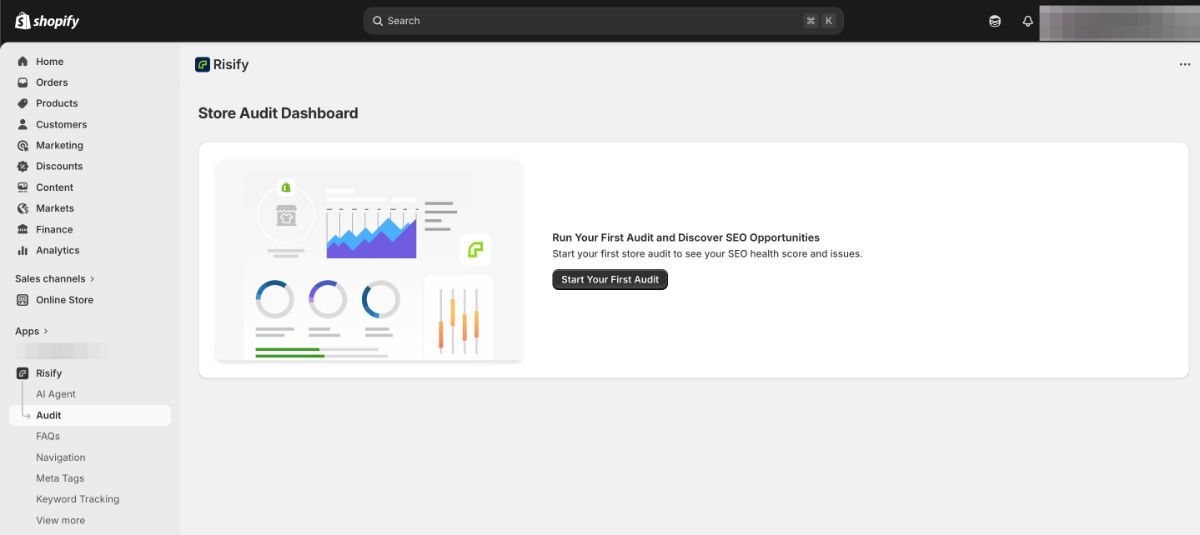
This post explains how the score is calculated, what gets scanned, and how to interpret the number you see.
📖 For a detailed walkthrough of the entire audit feature, see How to Audit Your Site With Risify post.
How the Health Score Is Calculated

The Health Score is a weighted percentage. It is not a simple count of how many issues were found divided by how many pages were checked. Instead, more serious problems pull the score down more than minor ones.
For example, a broken link issue on a high-traffic product page hurts your score more than a meta title issue that is slightly too short on a rarely visited collection. The weighting is applied automatically by Risify’s crawler technology using industry-standard severity levels.
You do not need to understand the exact formula. What matters is the direction: if the number goes up after you fix issues, your store’s SEO is improving. If it goes down, something new needs attention.
What Gets Scanned With Risify Audit
The audit scans your entire storefront by following links across the site. It picks up whatever is reachable, including:
- Products
- Collections
- Blog posts
- Regular pages (About Us, Contact, etc.)
- Your homepage
If a page is linked from your store, the audit will try to reach it. It is not limited to one content type.
For page speed testing specifically, Risify checks three key pages: your homepage, your top-selling product, and your largest collection.
How Many Pages Does It Cover?
Each audit currently scans up to 100 pages per store. For merchants with larger catalogs, the audit samples what is reachable first rather than scanning everything. Risify is expanding this to 1,000 pages per audit soon, which will give larger stores much broader coverage.
The Three Audit Categories
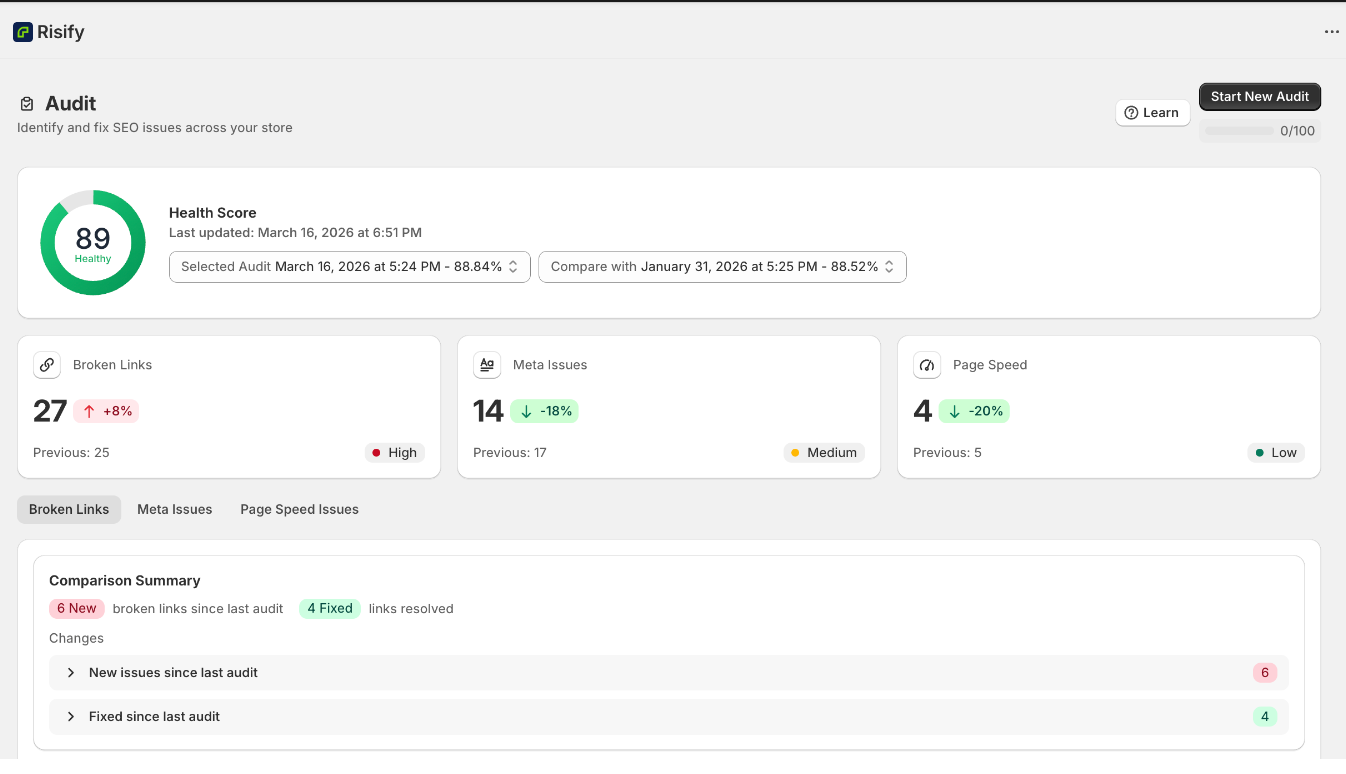
After the scan completes, your results are organized into three tabs:
- Broken Links: Pages on your store that link to URLs returning a 404 error. Each broken link shows the source page, the broken URL, and the status code.
- Meta Issues: Problems with your meta titles and meta descriptions, such as missing tags, titles that are too short, or duplicate descriptions. Each issue shows a priority level and an Edit button so you can fix it directly.
- Page Speed Issues: Performance metrics for both mobile and desktop, including Core Web Vitals (LCP, CLS, INP), supporting metrics (FCP, TTFB, Speed Index, TBT, TTI), and specific Opportunities and Diagnostics for improvement.
Each category contributes to your overall Health Score. For a detailed breakdown of what each tab shows and how to act on the results, see the dedicated guides:
- Audit Issues Explained: Broken Links
- Audit Issues Explained: Meta Tag Issues
- Audit Issues Explained: Page Speed
Tracking Your Score Over Time
Every audit is saved with a date. You can click the date on the dashboard to open a dropdown showing all past audits and review each score individually.
The Comparison Summary at the top of each category tab shows what changed since your last audit: how many new issues appeared and how many were fixed. This makes it easy to see whether your fixes are working and whether new problems have been introduced.
A good workflow is to run an audit, fix the highest-priority issues, then run another audit to confirm the fixes and update your score. Over time, your Health Score becomes a reliable indicator of your store’s SEO trajectory.
What Is a Good Score?
There is no universal benchmark because every store is different. A large catalog with thousands of products will naturally have more issues to manage than a small store with 20 items.
Focus on the trend rather than the number itself. A score that improves steadily over multiple audits means your SEO foundations are getting stronger. A sudden drop means something changed and needs investigation.